I alternate reading Zombie Apocalypse Books
 with books on child development and parenting. (This is my idea of balance, in case you were curious.) I'm reading Positive Discipline: The First Three Years
 , and Dr. Nelson emphasizes the need to think beyond "no" when it comes to discipline.
Children need boundaries, yes. But they also need to know that there are other possibilities, and that there is are options other than "yes" and "no". At my last job, my entire world was predominantly "Yes" and "Let's try something else," with only the occasional, "no". Our lives are structured (at least in part) by language; hearing "no" all the time creates a limited worldview.
We certainly say our share of "no"s ("No knives!" "No scissors!"), but this way we're not all "no" all the time. The "no" train runs both directions, which is why we're working on our language choices. I like to think of it as an exercise in creative, on-your-toes problem-solving. (My favorite is when Andrew says, "Let's redirect!" to Genevieve.)
I find myself saying things like, "We need to be kind with our hands/feet/teeth," and "We sit on our bottoms in chairs," and "Plates stay on the table." I'm telling Genevieve what she *should* be doing, instead of what she *shouldn't*.
Despite our drastic reduction in "no"s, a serious downfall with raising Genevieve multilingual is that we have gotten "NO!" in not one, but THREE languages (Mom's favorite being the angry "NEIN! NEIN! NEIN!"). Even so, we get WAY more "yeah"s, which I really and truly believe is because we're able to say it freely, and you know. Mousie see, Mousie do.
"Do you have a wet diaper?"
"Yeah." (Sometimes this isn't true. She's only 17 months old.)
"Would you like some cheese?"
"Yeah."
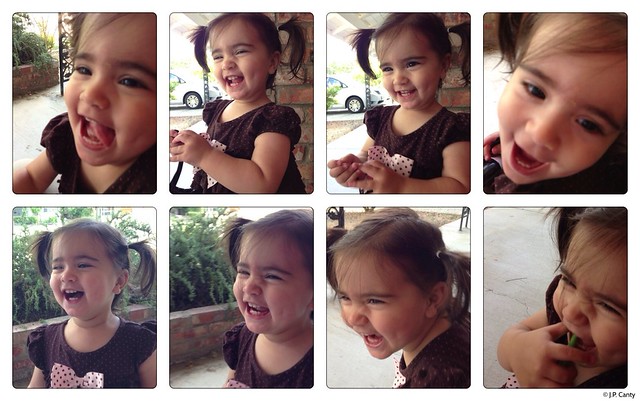
Hearing "yeah" from a toddler is like a choir of angels, and cuter than a litter of puppies sleeping in a pile. I'll admit to asking her questions just to hear her answer in her tiny little voice.
"I love you. Do you love me?"
"Yeah."


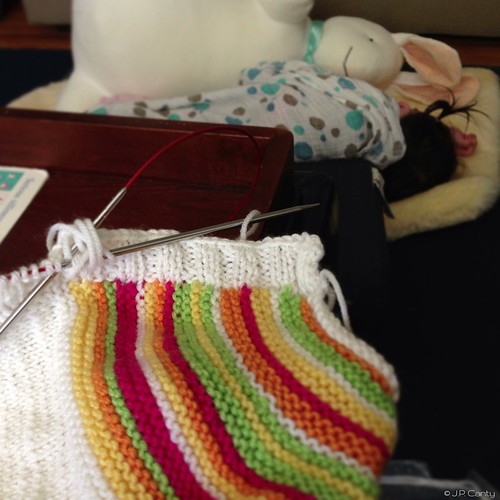
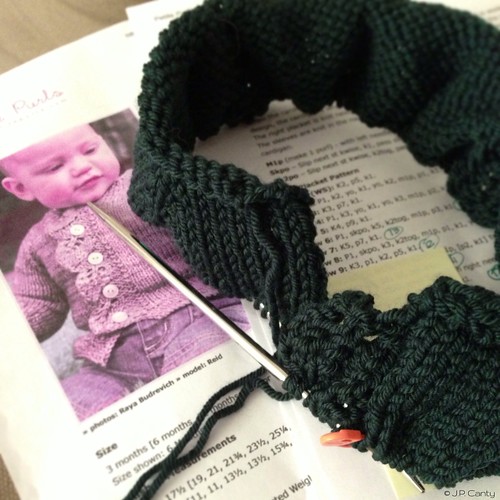
 , which I've had memorized for some time now. "On Sunday, he had one nice green leaf, and he felt much better."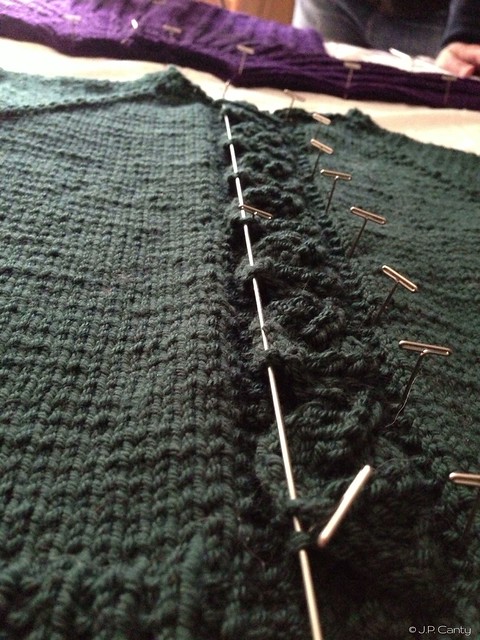
 on this sweater. I dug through my button box and found caterpillars, but it wasn't enough. We found oranges, grapes (not entirely accurate, but close enough), strawberries, a butterfly, and apples (with the help of a friend). I also found grosgrain ribbon with The Very Hungry Caterpillar.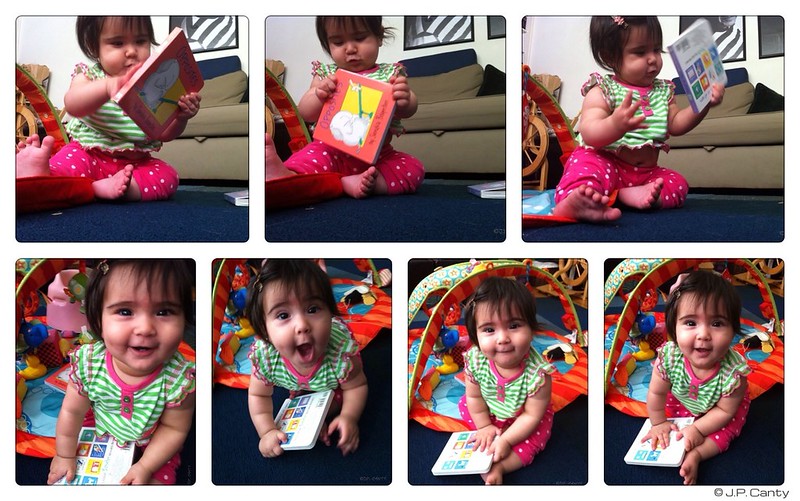
 and
and  , because that's how we roll), and they're a lot of fun. I especially enjoy Genevieve reading them back to me, since she has figured out that we talk at books. (There has been some very enthusiastic babbling.)
 Posts
Posts